 Skip to content


- Why This Flight Only Happens on the Brazilian Side
- What It Feels Like to Fly Over Iguazu Falls
- What to Know Before You Go
- Is It Worth It? Who This Experience Suits Best
- How to Pair It With the Rest of Your Iguazu Visit
- Planning Your Iguazu Falls Helicopter Tour
- Frequently Asked Questions About the Iguazu Falls Helicopter Tour
This article explains what an Iguazu Falls helicopter tour feels like, why it only operates on the Brazilian side, and whether it deserves a place in your itinerary. You will find what a scenic flight over Iguazu Falls reveals that the trails do not, the practical details worth knowing, and how it fits into a Brazilian-side day.
It is one of the most asked-about additions to an Iguazu trip, and one of the easiest to misjudge from a tour listing. A few minutes in the air change how most travelers understand the scale of the falls.
As a Brazil-based concierge that has arranged this flight for guests many times, our aim here is to give you a clear, ground-level account before you decide.
- Argentina: helicopter flights are banned across the park for wildlife protection reasons.
- Brazil: currently the only side of the border where a helicopter ride over Iguazu Falls operates for visitors.
- Flight path: stays within Brazilian airspace, with views across both countries’ sections of the falls.
- Location: the heliport sits near the park entrance, close to Parque das Aves.
- The full arc of Iguazu Falls in a single frame, something no ground viewpoint allows.
- The Devil’s Throat from above, its horseshoe shape wrapped in a column of rising mist.
- The Iguazu River winding through dense, largely undisturbed rainforest.
- Sections of the Argentine park across the gorge, visible from Brazilian airspace.
The Devil’s Throat, the deepest section of the falls, looks almost calm from this height, a wide void wrapped in its own mist. Pilots tend to circle this part of the route more than once, giving passengers on both sides of the cabin a clear view. Below, the forest stretches uninterrupted in every direction, broken only by smaller cascades most visitors on the trails never notice.
What stays with people is not one image but the sense of scale. A trail walk reveals the falls one viewpoint at a time. Seeing Iguazu Falls from above reveals them as a single, continuous system, the river and the forest as much a part of the picture as the water itself.

Because the standard flight typically carries a small group, you may be paired with other travelers, and no exact time slot can be guaranteed.
It tends to suit:
- Travelers who have walked the trails and want a complementary perspective.
- Photographers wanting one complete image of Iguazu Falls from above.
- Short-stay travelers fitting Iguazu into a one or two day visit.
It tends to matter less for:
- Travelers with limited mobility, since boarding involves a short walk and a step into the cabin.
- Anyone with a strong fear of heights or enclosed spaces.
- Guests on a tight schedule better spent at the falls or the bird park.
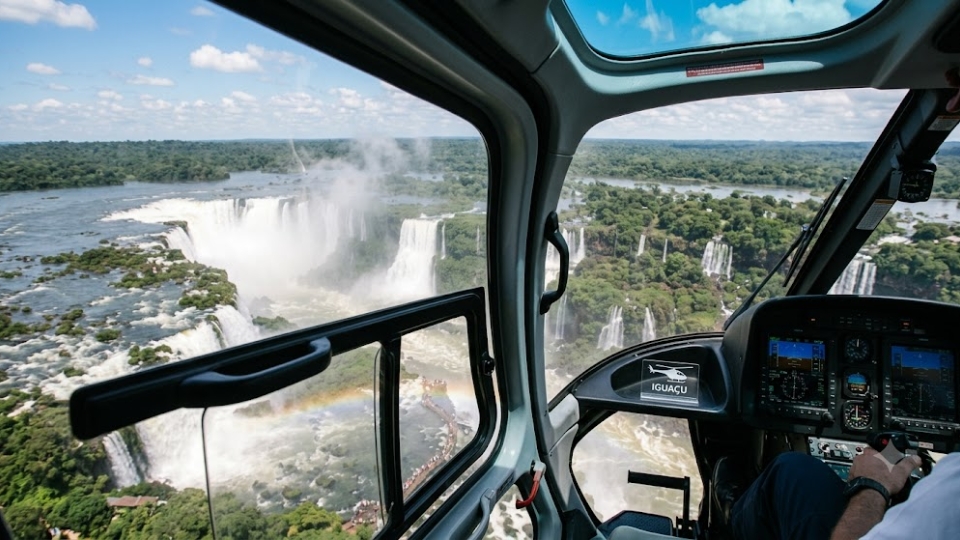
Our honest view, after arranging this flight often, is that it rewards people who already understand what they are looking at. Seen after the trails, it clicks into place as the missing piece. Seen instead of them, it can feel like a photograph without the story behind it.
- Morning: the Brazilian-side trail toward the Devil’s Throat, before midday crowds.
- Early afternoon: an hour or two at the bird park.
- Late afternoon: the helicopter flight, when conditions tend to be calmer.
This order also works better with the weather, since placing the flight after the ground-based parts of the day gives you a buffer if it needs rescheduling.